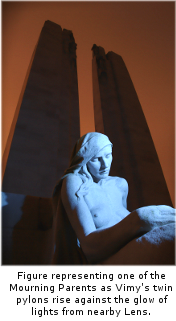
The Canadian assault on Vimy Ridge was planned by a former real estate agent from Victoria, B.C., General Arthur Currie, and a physicist from McGill University in Montreal, Colonel Andy McNaughton.  They had a British commander, like all the Dominions, but this commander, Sir Julian Byng, (later a Governor General: the
representative of the monarch
(crown), appointed on the
advice of the Prime Minister
for a term of five years.Governor General of Canada) had the good sense to let the Canadians run their own show.
They had a British commander, like all the Dominions, but this commander, Sir Julian Byng, (later a Governor General: the
representative of the monarch
(crown), appointed on the
advice of the Prime Minister
for a term of five years.Governor General of Canada) had the good sense to let the Canadians run their own show.
Instead of sticking to the old British approach of frontal attacks on the enemy, the Canadians under Currie decided to analyse the situation first. They used trigonometry: the branch of mathematics that deals with the relations between the sides and angles of triangles and the calculations based on these.trigonometry to figure out exactly where the enemy fire was coming from. And they used a new instrument, the oscilloscope: an electronic instrument for representing wave patterns on the screen of a cathode-ray tube.oscilloscope, to measure the muzzle velocity of their heavy guns. With this information they could set all the sights of their guns to fire volleys that would land in a straight accurate line on the German trenches. Canadian troops could advance more quickly behind this barrage: a barrier of artillery fire to check the enemy or to protect one's own soldiers in advancing or retreating.barrage because the line of danger from falling explosive projectiles was narrow and predictable. The Germans, expecting a long delay between the end of the barrage and the arrival of troops, were surprised by the sudden appearance of Canadian soldiers on the brow of the trench.
In two hours the Canadians had taken Vimy Ridge. More than 3000 Canadian young men lost their lives at Vimy and another 7000 suffered injuries, but these horrible casualties were still far less than the British and French had sustained without success, and headlines around the world praised this incredible Canadian achievement.
1915 YPRES, FRANCE
Another famous Canadian battleground was near Ypres, in the Belgian province of West Flanders.
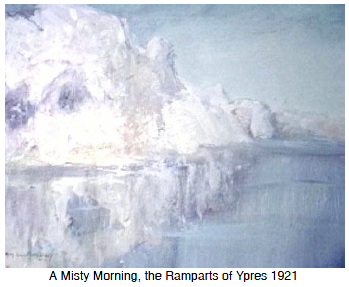
This painting by Mary Riter Hamilton was commissioned after the war to mark the battle.
It was at Ypres that poison gas was first used successfully as a weapon of war. On April 22, 1915, the Germans attacked releasing over 160 tons of chlorine gas that wafted in a greenish-yellow cloud toward the allied lines. Chlorine gas turns into hypochlorous acid when it is combined with water, so damage to the eyes and lungs was severe. Many died within minutes from suffocation. Chlorine gas is denser than air, too, so it fell into the trenches, forcing the soldiers to climb out and put themselves into the line of fire.
The French and Algerians, taking the brunt of the attack, abandoned their positions creating a 6.4 km gap in the allied line to the left of the Canadians. In their first major battle of the war, Canadians stepped in and over the coming days managed to hold on, even though their Ross rifles jammed and the urine-soaked cloths they put to their faces provided small defence against the gas. The 2nd Canadian Brigade at Ypres was led by Arthur Currie who would also be instrumental in the Canadian attack on Vimy Ridge two years later. It was during this Battle of Ypres that the Canadian doctor and Lieutenant Colonel John McCrae wrote the famous poem "In Flanders Fields."
1918 >>